
Galapagos Flights and prices |Galapagos Hotels | diving tips | About us | FAQ | Booking and Payments | News
General Information | Yachts Information | History | Geology | Flora & Fauna | Ecuador
Oceanography | Islands | Diving | Reservations | home | sitemap
e-mail: Contact Us
US Toll Free # 1-800-426-0802
Outside US.or Canada 1-305-332-3099Telefax 954 967 2547
|
||||||||||||||||||||||||||||||||||||||||||||||||||||||||||||||||||||||||||||||||||||||||||||||||
































Española | Floreana | San Cristobal | Santa Cruz | South Plaza | James (Santiago) | Bartatalome | Tower (Genovesa) | Isabela | Fernandina |North Seymour | Rabida (Jervis) | Santa Fe
![pictures/SouthCliffs[1].jpg](pictures/SouthCliffs%5B1%5D.jpg)
Is one of the oldest of the Islands. It is small and flat, without any visible volcanic crater or vent. Gardner Bay on the eastern shore offers the island's most magnificent beach. It is used by a transient colony of the sea lions, and is a major nesting site for marine turtles. Around the small islets nearby snokerler's will find fish and sometimes turtles and sharks. The trail leads from here to Punta Suarez, on the western tip of the island. Along the way you will pass the nesting site of almost all the world's waved albatross, huge birds with a 6-foot wingspan. Punta Suarez is one of the most outstanding wildlife areas of the archipelago, with a long list of species found along its cliffs and sand or pebble beaches. In addition to five species of nesting seabirds, Galapagos doves and sometimes Galapagos hawks can be seen. The Hood mockingbird is very curious and bold. Several types of reptiles, including the brilliantly colored marine iguana and the oversized lava lizard, are unique to this island. When heavy swells are running, Punta Suarez is also the site of a spectacular blowhole, with thundering spray shooting thirty yards in the air.
(top)
Is the best known for its colorful history of pirates, whalers, convicts and.by British whalers to send letters to and from England. This tradition has continued over the years, and even today. This tradition has continued over the years and even today visitors may drop off and pick up letters, without stamps, to be carried to far off destinations. Punta Cormorant offers two highly contrasting beaches. The landing beach is of volcanic origin and is composed of olivine crystal, giving it a greenish tinge. At the end of the short trail is a carbonate beach of extremely fine white sand. Formed by the erosion of coral skeletons; it is a nesting site for green sea turtles. Between these two beaches is a salt lagoon frequented by flamingos, pintails, stills, and other wading birds. An old eroded volcanic cone called Devil's Crown is a popular roosting site for seabirds such as boobies, pelicans, and frigates. Red-billed tropicbirds nest in rocky crevices. The center of the crown is an outstanding snorkeling spot full of sea lions and colorful fish.
Diving in Floreana is amazing. There are 9 dive sites here with generally calm waters. On the occasion that we do find strong currents, we can quickly move to another site, which makes Floreana ideal for all levels of divers. This site is one of the best in the southern islands to see significant coral colonies, such as pebble coral and endemic black coral. You Y might encounter baby birds as they make unsuccessful attempts learning to fly. You may look on as barber fish clean sea turtles of parasites. Floreana is also one of the best sites to dive with sea lions. If that isn’t enough there is the enticing gauntlet of sea horses, stingrays, eagle rays, turtles, long nose hawk fish, barracudas, pelagic fish, white tip reef sharks, Galapagos sharks, and hammerhead sharks.
(top)
Is geological one of the oldest, reflected by eroded volcanic peaks in the north and densely vegetated slopes in the south. The town of Puerto Baquerizo Moreno is the capital of Galapagos province. A bus ride through highland farms brings you to El Junco, the only freshwater lake in Galapagos. Cruise to spectacular kicker rock, or Leon Dormido, the jagged, whose flanks are covered with seabirds.
(top)
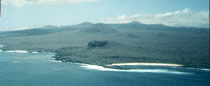 Supports one of the largest human populations of the five inhabited islands. Some 10,000 residents are distributed between the cattle farming communities in the lush highlands and the coastal town of Puerto Ayora. Here you can visit the Charles Darwin Research Station to see the huge land tortoises, which once flourished in the islands. The populations were decimated in the early 1800's by the whaling ships that stopped in the islands to fill their holds with fresh meat. A bus ride into the highlands takes you to Los Gemelos, two deep pit craters situated in the scalesia forest with lots of interesting bird life, or for a trek through the gigantic lava tubes, or to the Tortoise Reserve to search for large tortoises in their natural habitat. For Diving On the north shore of the island, accessible only by the sea, is an extensive mangrove lagoon called Black Turtle Beach. Here in the peacefulness of the mangroves turtles break the surface of the still waters, while fish, rays and small sharks cruise below.
Puerto Ayora.-This is the bay of Puerto Ayora on Santa Cruz Island with 4 dive sites . Three of the sites are generally calm with little current; ideal for students or novices.
At the other site, the dives can be a little more complicated if there is a current so they are suitable for intermediate or expert divers. Frolic with sea lions or listen as the damselfish munches away at its algae farm. You may also see marine iguanas, rays.
The Town is full of gift and souvenir stores, as well as all sorts of Ecuadorian craftwork. Although the prices are much higher than stores on mainland Ecuador, they are cheaper than the cruise ships’ boutiques.Puerto Ayora is the place to be for nightlife in the Galapagos. In the center of the archipelago, Santa Cruz Island has a fair number of pubs and discotheques that stay open until late into the night.
(top)
Is one of the smallest islands to be visited. A large colony of sea lions, numbering about 1,000 bulls, cows and pups, occupies the smooth rocks here. The small cactus forest is populated by land iguanas, which can be seen sunning themselves or feeding on opuntia pads and fruits. Along the cliff's edge nesting swallow tailed gulls are the predominant seabirds, along with tropicbirds and shearwaters. During the rainy season the dormant ground cover undergoes a drastic change. The red sesuvium turns bright green and the leafless evening blooming partulaca burst into large yellow flowers that are relished by the land iguanas.
GORDON ROCKS
This tuff cone formation close to South Plazas, is a world famous dive site . There are 4 dive sites in the area, but only two are for novices. The other two sites are for intermediates and experts because there can be strong currents and surge. The Gordon Rocks dive sites are
mostly walls with a deep bottom. Blend in and blow a few bubbles and you may be blessed with a hammerhead sighting! Hammerhead sharks are the main attraction of Gordon Rocks, where they often congregate in large schools. You won’t be able to stop looking at this aquarium as you’re likely to also see reef fish, large pelagic fish, golden rays, stingrays, eagle rays, turtles, morays.
(top)
Has several sites to visit in the region of James Bay at the western end. Puerto Egas with its black sand beaches was the site of small salt mining industry in the 1960's. A hike inland to the salt crater is an excellent opportunity to sight land birds such as finches, doves, and hawk. A walk down the rugged shoreline, especially at low tide will turn. ,sea lions laze in the tide pools. A the end of the trial there is a series of grottoes or sea caves where fur seals and night herons are found resting on shady ledges. The seals
are easily enticed to join you for a swim in the clear waters. Just north of James Bay in Buccaneer Cove, a particularly scenic area to steep cliffs and dark beaches. A large population of feral goats now frequents this part of the island. Part of the point has been fenced off to protect the native vegetation from their destructive foraging. On the eastern coast of James Island is Sullivan Bay, a large area of fresh pahoehoe (ropey) lava flows dating from an eruption in 1897. A walk over this glazed black rock gives the impression of the molten lava, as every ripple, swirl, and bubble in its surface has been preserved. Only the occasional pioneering mollugo plant gives a clue of the time needed for species to colonize such an expanse.
(top)
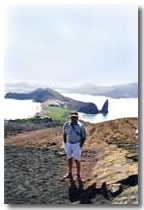
Is a small island that offers beautiful white sand beaches fringed by luxuriant green mangroves. The eastern end of the island has many volcanic cones and lava tubes. Climb to the summit of the island for one of the most breathtaking views in the island. The tall, leaning spike known as Pinnacle Rock is the eroded remains of an old tuff cone. At its foot is a beach. and a tiny colony of Galapagos penguins.
(top)
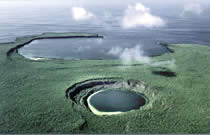 Is a low volcano barely breaking the surface of the ocean. Ships sail directly into its large breached caldera to anchor at the foot of the steep crater walls. It attracts vast numbers of pelagic seabirds who come here to nest. Great frigate birds, red-footed boobies, swallow-tailed gulls and yellow-crowned night herons are seen, then along the low shurbs populated by frigates and boobies and eventually to a cliffs edge where sea birds soar. A second trail leads to an open area for masked boobies, more frigates, and red-foots. At the end of the trial thousands of band-rumped storm petrels flutter at the cliff's edge, where they nest in crevices. Short-eared owls can sometimes be seen here, hunting the storm petrels during day light hours.
(top)
Tagus Cove. Created by the lava of six volcanoes that flowed together, this 1800 squared foot island is the largest in Galapagos. Graffiti dating back to the 1800's is written on the rocky cliff left over from bucanneers and whaling ships. The trails lead to a salt water lagoon and offers a great view of the lava fields and the ocean. A Panga ride reveals penguins, shearwaters and noody terns.
(top)
 Located on the west side of Isabela Island, it is the western most island in the Galápagos and is one of the most volcanically active. The main volcano is 1,500 meters high with a diameter of 6.5 kms and a depth of about 800 meters. Punta Espinoza is visited to see the black lava rock, mangroves, a variety of herons, Yellow Warblers, Pelicans, Frigates, the Mangrove Finch, petrels, shearwaters and Marine Iguanas.
(top)
Located directly to the north of Baltra Island, Seymour is famous for its colony of Frigates found on the south west side of this small island. Also found on this island are Blue Footed Boobies, Land Iguanas, Swallow-tailed Gulls, pelicans and Red-billed Tropic Birds.
Diving. North Seymour is an uplifted island of lava flow about 90 minutes north of our dive base. There are 5 dive sites suitable for all levels of divers, although sometimes the currents can be strong.
These sites have the most different species per square foot of sandy bottom. We can see cleaning behavior, a lar or ge garden eel colony, sea turtles, sea lions, fur seals, eagle rays, yellow-tailed grunts, big-eyed jack, and frequently white tip reef sharks and hammerheads. Occasionally, Galapagos sharks can also be seen here.
(top)
A small island just over 2 kms in width and 400 meters at its highest point, located to the south of Santiago Island. Rábida is known for its unusual red coloured beaches. The vegetation consists mainly of Opuntia Cactus, Palo Santo trees and scrubby bushes. Upon your wet landing you will probably see various sea lions and after a short hike you will reach the lagoon to see flamingos and pelicans.
(top)
Located directly to the north of Baltra Island, Seymour is famous for its colony of Frigates found on the south west side of this small island. Also found on this island are Blue Footed Boobies, Land Iguanas, Swallow-tailed Gulls, pelicans and Red-billed Tropic Birds.
Diving in this island is a solid structure of basaltic lava rocks with 4 dive sites here generally have excellent visibility and mild currents, making these sites ideal for novices. At the same time, the animals and topography (including a spectacular arch) make them interesting for intermediates and experts. We can see stingrays, eagle rays, garden eels, turtles, sea lion colonies, morays, pelagic fish, and maybe white tip reef sharks and/or hammerhead sharks.
Beagle Rocks
These are 3 exposed rocks located south of Santiago Island, about 1h30’s cruise from Itabaca channel in Santa Cruz. This beginner/intermediate dive site starts on a 12 meter deep platform and leads to a wall, covered with black coral and sea fans, that drops to more than 60 meters. Pelagic species that can be observed include hammerheads, Galapagos sharks, mantas during the hot season, small rays, turtles and sea lions.
Pinzon
The small island of Pinzon is located on the west side of Santa Cruz Island, about a 90 minute cruise away from Puerto Ayora. This beginner/intermediate dive site is on the east side where 2 tower-shaped rocks emerge. A wall covered in black coral drops to 10 meters and from there it’s a sandy slope that drops to more than 50 meters. Species commonly observed include the red lipped bat fish, sea horses, sting rays, turtles and white tip reef sharks.
Cousins Rock
An islet with a wall dropping from the surface into the deepest depths, Cousins Rock is home to a big area of sloping rock plates known as a “Planchonal” about two hours from our base. There
can be strong currents here that separate the productive and unproductive sides of the dive site. Cousins’ is full of spectacular endemic young black corals and other sightings may include
frogfish, fur seals, sea turtles, sea horses, and usually, hammerhead sharks.
Daphne
This is an isolated offshore tuff cone with vertical walls all around it . The main dive site is a shelf of boulders at about 60 feet and the diving can be difficult depending on the currents and surge. We usually see many Galapagos sharks here, some schools of pelagic fish, and multicolored sponges on the rock wall.
Guy Fawkes
These 4 islets are located on the northwest side of Santa Cruz Island, about a 75 minute cruise from Itabaca channel. In general, the ocean bottom descends in slopes, some almost vertical.
The walls of the islets are eroded, full of cavities in some parts, and big rocks covered in black coral in others. At this intermediate site divers can observe pelagic species such as Galapagos sharks, white tip reef sharks, turtles, and a wide variety of reef fish and sea lions.
Nameless Rocks
This nameless islet is located offshore on the west side of Santa Cruz Island, about a 75 minute cruise from our base. This intermediate/advanced site is exposed to strong currents and surge.
It is mostly a wall dive where many species of coral, sponges and gorgonians can be observed and where a good control of buoyancy is mandatory. Since the site is exposed to strong conditions it attracts mainly large pelagic species such as hammerheads, Galapagos sharks, barracudas, tunas, turtles and a wide variety of reef fish.
Galapagos Flights and prices |Galapagos Hotels | diving tips | About us | FAQ | Booking and Payments | News
General Information | Yachts Information | History | Geology | Flora & Fauna | Ecuador
Oceanography | Islands | Diving | Reservations | home | sitemap
Copyright © 2006 Galapagos Divers. All rights reserved.